

Jak Petzold
LSSSE Research Analyst

Law schools have an important role in preparing students to practice law ethically. But how much do students feel their law school contributes to their personal development of values and ethics? And does a school's emphasis on ethical practice relate to students' perceptions of their own ethical development? To find out, we analyzed students’ responses to two LSSSE questions:
1) To what extent has your experience at your law school contributed to your knowledge, skills, and personal development in developing a personal code of values and ethics?
2) To what extent does your law school emphasize encouraging the ethical practice of the law?
The results offer some interesting insights.
Law Schools' Contributions to Ethical Development
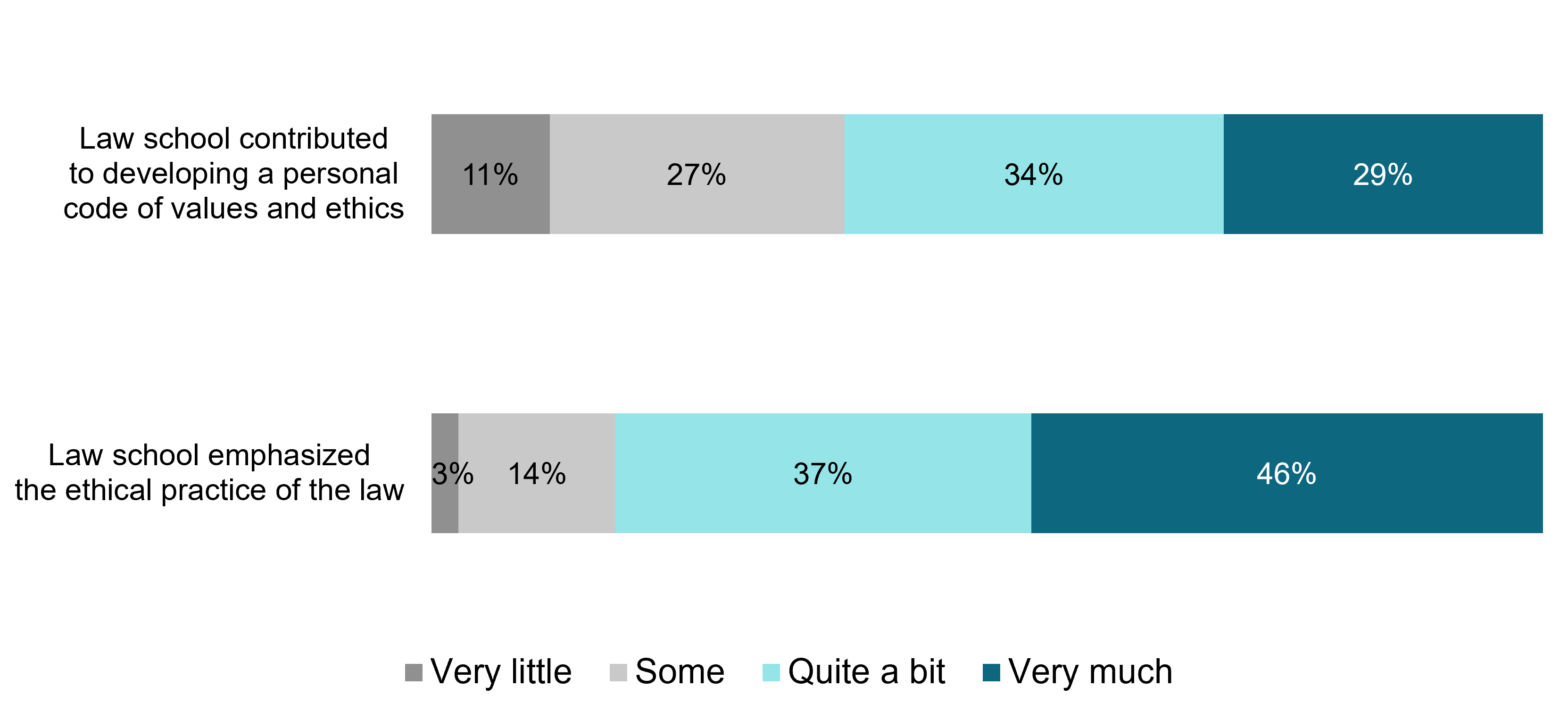
Overall, students view their law schools more favorably when it comes to emphasizing ethical legal practice than when it comes to helping students develop their own personal codes of values and ethics. A substantial 83% of students said their law school emphasized encouraging the ethical practice of law "Quite a bit" or "Very much." By comparison, 63% said their law school contributed "Quite a bit" or "Very much" to developing their personal code of values and ethics. This difference suggests that while law schools are generally successful in communicating the importance of ethical practice, students are somewhat less likely to see an equivalent level of growth in developing their own personal values. It is possible that most students enter law school with a well-defined code of personal values and ethics and thus do not see a reason for further development, or it may be that law school is more likely to encourage looking outward at ethics within the structure of the legal system rather than encouraging students to look inside and reflect on their own personal values.
The Relationship Between Ethical Emphasis and Personal Development
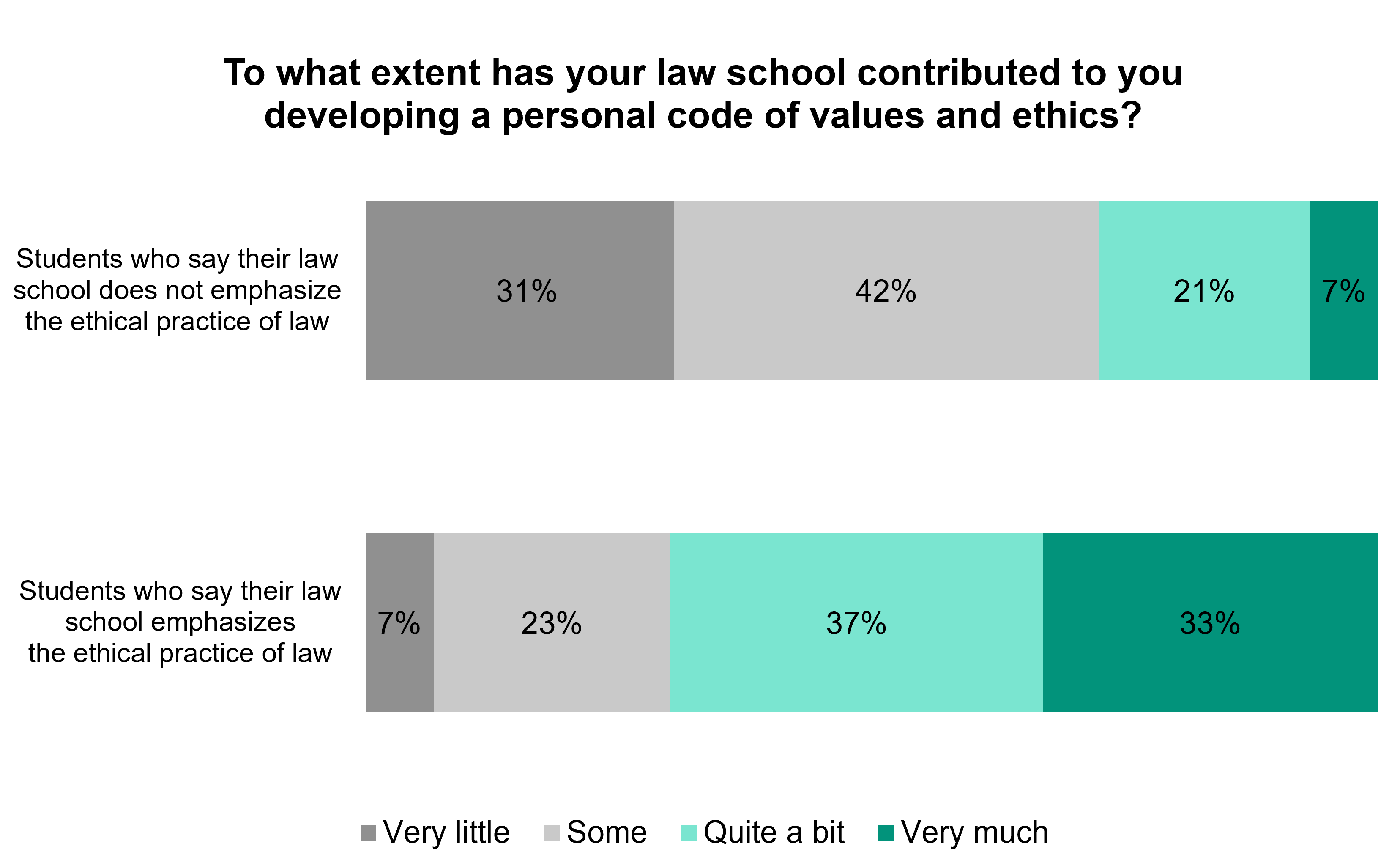
To explore this relationship further, we divided students into two groups: those who said their law school emphasized ethical practice "Very little" or "Some," and those who responded "Quite a bit" or "Very much." The differences between these groups are striking. Among students who perceived relatively little emphasis on ethical practice, just 28% said their law school contributed substantially ("Quite a bit" or "Very much") to developing their personal code of values and ethics. In contrast, 70% of students who perceived a stronger emphasis on ethical practice reported substantial contributions to their personal ethical development, a difference of 42 percentage points. In other words, students who see their law school placing a stronger emphasis on ethical legal practice are also much more likely to feel that their school has contributed to their own ethical development.
Conclusion
We cannot determine causality from these data. A stronger emphasis on ethical practice may contribute to students' personal ethical development, but other factors could influence both responses. For example, students' overall satisfaction with their law school experience might shape how they answer both questions. Nevertheless, the findings suggest that law schools may be doing a better job of emphasizing ethical practice than of fostering students' personal ethical development. They also highlight a strong relationship between these two perceptions where students see more personal growth when their law school emphasizes ethical practice. For law school professionals, the results offer a reminder that teaching ethical obligations is important but that helping students connect those obligations to their own values and professional identities may be equally important.